
Related reading
EDGE CATALOG DELIVERY FOR B2B COMMERCE
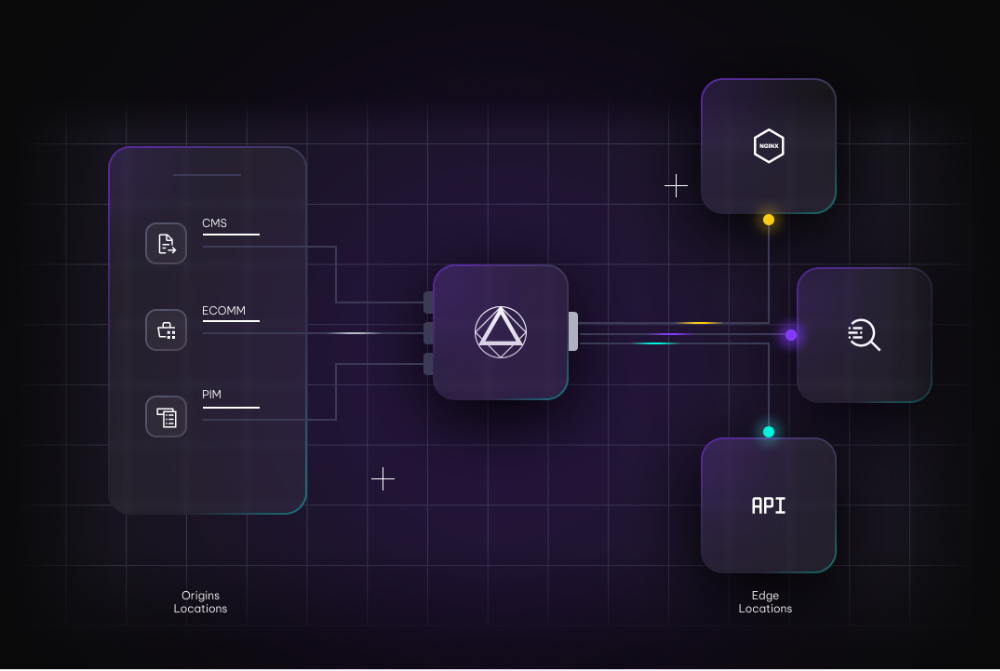
StreamX orchestrates product data delivery from every source system and triggers an update to the edge before the next request arrives. No batch job, no waiting on the next sync.
THE PROBLEM
Content, pricing, availability, and specs live in different systems that don't update on the same clock. Keeping them in sync means batch jobs running on a schedule, so between runs, your catalog is always partly out of date. At a few thousand SKUs, that's not an edge case, it's the default state.
Inventory moves on its own schedule, often a batch job that runs later. Until it catches up, the page says one thing and the warehouse says another, and customers order into the gap.
Caching exists so a backend isn't exposed to direct traffic. Data can be controlled directly, a cache can't, so it ends up either overcached, showing stale data, or undercached, sending traffic to a backend that wasn't built for it. Fixing one risk means accepting the other, right when traffic is heaviest.
A product page assembled from pricing, inventory, and content systems at request time is only as fast as whichever one is slowest to respond that day. Add more systems and the odds get worse, not better.
Dimensions, materials, and compatibility details aren't just page content, they're what search and filters are built on. When that data lags, a product either disappears from a filtered search or shows up with details that don't match what's actually true. Either way, a buyer can't act on information they can't find, or trust.
THE SOLUTION
StreamX created a unified data layer for catalog delivery. It doesn't wait for the next batch job to notice a change. When something changes in your PIM, ERP, or commerce platform, StreamX receives that event and acts on it, triggering whatever needs to update next. What StreamX delivers to the edge is whatever you configure: an API, a search index, or a database that stays current. The difference isn't which systems StreamX reads from. It's that StreamX knows the moment something changes instead of finding out on the next sync.
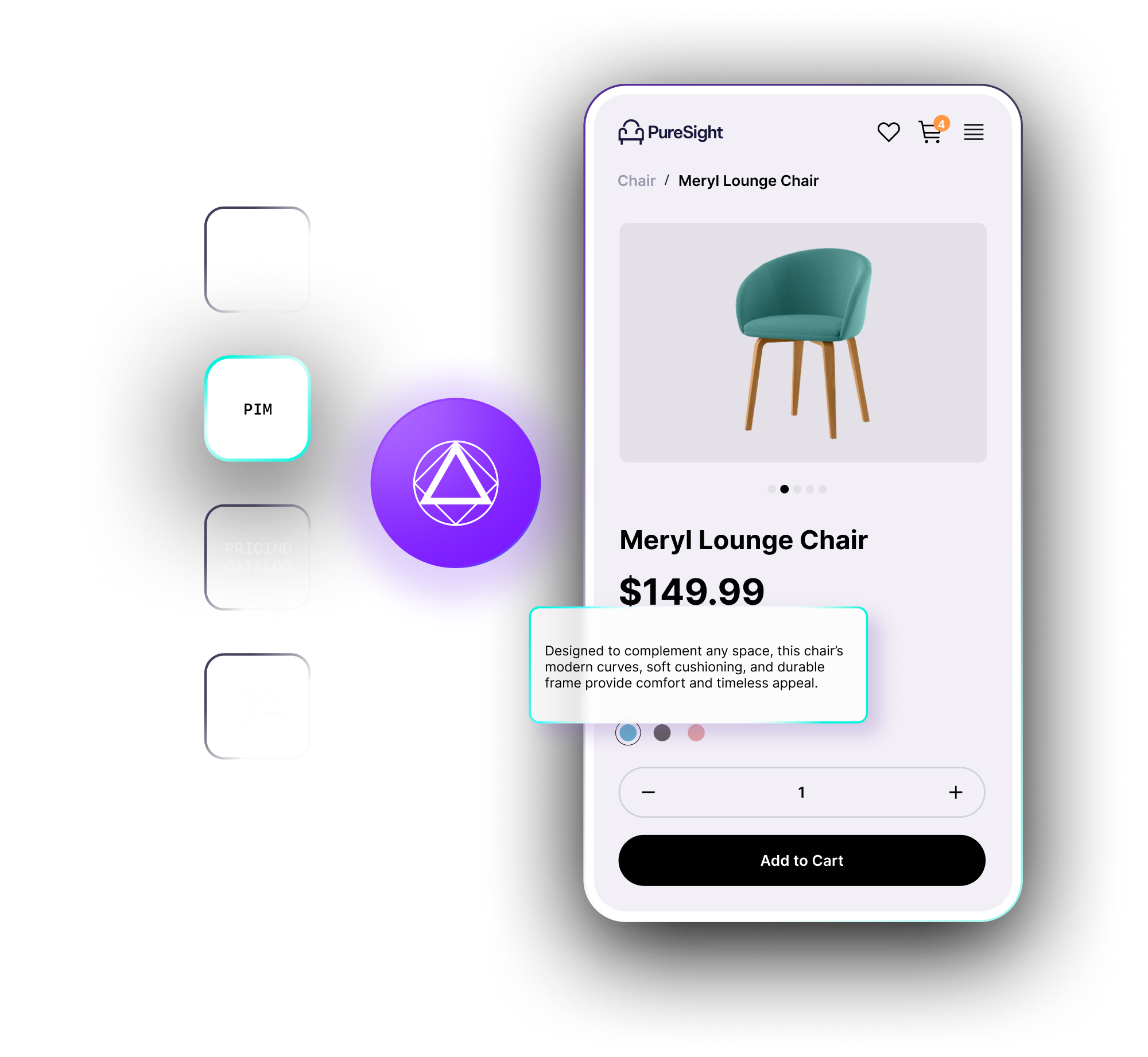
Category listings, filtered results, and product pages are all built from the same unified data layer. A single update is reflected everywhere that product appears instead of each location catching up on its own schedule.
Attributes, categories, variants, and specs come from the source systems that already manage them. StreamX keeps that structure current every time it changes. It doesn' t invent structure that isn't there.
When a source system changes, StreamX knows exactly which product changed. That change triggers a rebuild at the edge, distributed to locations close to your users, so response time doesn't depend on how far a request has to travel back to a central system.
StreamX includes production-ready connectors for AEM and Adobe Commerce, which also covers Magento. They listen for changes automatically and send them into StreamX's continuous materialization pipeline. For PIM, ERP, or other source systems, you build on the same connector framework instead of writing integration code from scratch.
Product data still lives in separate systems, StreamX doesn't sync them with each other. What it does is deliver a consistent view of that data everywhere it's needed, without point-to-point integration code for every source. Teams spend less time on custom integration work and more time building.
Add more SKUs, add more regions, add more traffic. None of it changes how fast a page loads, because pages are prepared ahead of time instead of assembled live for every visitor. You scale by adding data, not by redesigning delivery.
A price or availability change doesn't just update a product page. The same event can trigger a new sitemap, product recommendations, or anything else that depends on that data staying current. The unified data layer that solves today's problem is already built for whatever gets added next.
PIM, ERP, commerce, CMS, DAM: StreamX orchestrates delivery from all of them, so a change reaches wherever it's needed, without a separate integration for each source. Add a new system later, and it plugs into the same framework instead of starting over.
What happens between a source system change and a page that reflects it.
See it working on day one, not after the build
Start with production-ready connectors, a reference storefront to build from, and an architecture designed for catalog data that changes constantly. Configure what's already there instead of building it from scratch, and have a catalog that reacts to change live from day one.
If you're on Adobe Commerce, a lot of the foundation is already in place. The commerce accelerator is a working starting point built for Adobe Commerce, a unified data layer connected to a storefront kit, the core integrations, and the materialization services below. It still needs to be configured for your catalog and storefront, but implementation starts from something running, not a blank repo.
Go-to-market
Integrations and observability
Performance
Built on Tailwind, with a Product Detail Page, Category Page, and Product Listing ready to use.
Includes Adobe Commerce, Adobe Experience Manager, Edge Delivery Services, Universal Editor, and document-based authoring.
Live search, facet filtering, sitemap generation, a template engine, and JSON generation for headless, ready to start with and customize as needed.
Pre-configured to orchestrate the flow of product data, such as details, prices, and availability, and ready to extend to fit your specific business needs.
A standardized way to represent product data that maps to most e-commerce platforms, making it easier to integrate or replace the systems underneath.
Organized for easier maintenance within an organized project structure.
Runs on Grafana Labs' opinionated observability stack: Loki for log management, Grafana for visualization and dashboards, Tempo for distributed tracing, and Mimir for metrics storage and querying.
Runs on Docker, containerizing the deployment environment and ensuring consistency across every stage.
Provisioned with Terraform, supported across most leading cloud providers.
Runs on Apache APISIX, handling API gateway configuration and routing for the mesh.
Go-to-market
Built on Tailwind, with a Product Detail Page, Category Page, and Product Listing ready to use.
Includes Adobe Commerce, Adobe Experience Manager, Edge Delivery Services, Universal Editor, and document-based authoring.
Live search, facet filtering, sitemap generation, a template engine, and JSON generation for headless, ready to start with and customize as needed.
Integrations and observability
Pre-configured to orchestrate the flow of product data, such as details, prices, and availability, and ready to extend to fit your specific business needs.
A standardized way to represent product data that maps to most e-commerce platforms, making it easier to integrate or replace the systems underneath.
Organized for easier maintenance within an organized project structure.
Runs on Grafana Labs' opinionated observability stack: Loki for log management, Grafana for visualization and dashboards, Tempo for distributed tracing, and Mimir for metrics storage and querying.
Performance
Runs on Docker, containerizing the deployment environment and ensuring consistency across every stage.
Provisioned with Terraform, supported across most leading cloud providers.
Runs on Apache APISIX, handling API gateway configuration and routing for the mesh.
Answers to some of the most common questions about how StreamX works with B2B catalog data.
A change in a source system, PIM, ERP, commerce, CMS, or DAM, triggers StreamX to act on that change and deliver the update to the edge. There's no batch job or scheduled sync in between.
StreamX acts the moment the source event fires and delivers the update to the edge before the next request, fast enough that the gap goes unnoticed.
Data sources such as PIM, ERP, commerce, CMS, and DAM stay exactly where they are, as your systems of record. StreamX doesn't replace them or become a new place to manage product data.
Product, category, listing, filter, and discovery views built from your source data, plus whatever attributes, variants, and specs your catalog needs.
Yes. StreamX can combine product attributes, documents, media, categories, availability, and regional rules from multiple systems into a single, current view, delivered to the edge so it's ready before a request comes in instead of assembled live from separate systems each time.
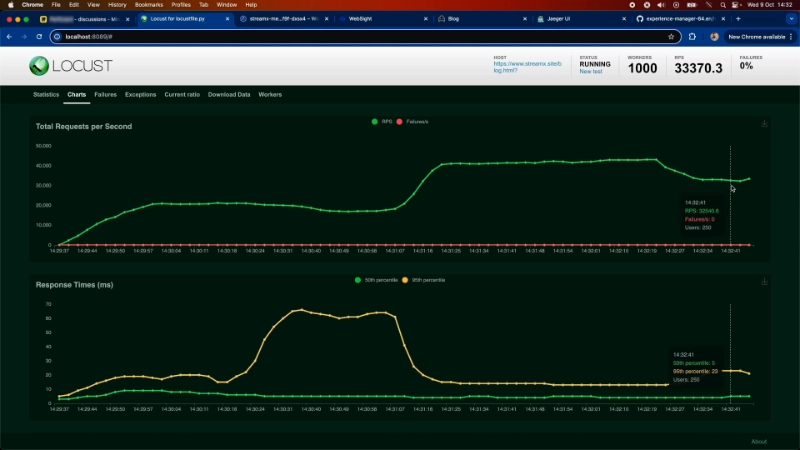
WATCH: 12M product updates with zero errors
Watch StreamX in action as we test the system resilience, performance, scalability, and latency for both processing and delivery.
Kamil Chociej
StreamX Prinicpal Engineer & DevOps
Ready to see what StreamX can do for you?